
Signal Example — Sampling & Reconstruction
Interactive demonstration of the Nyquist–Shannon sampling theorem.
This demo shows how sampling rate affects the reconstruction of a sine wave.
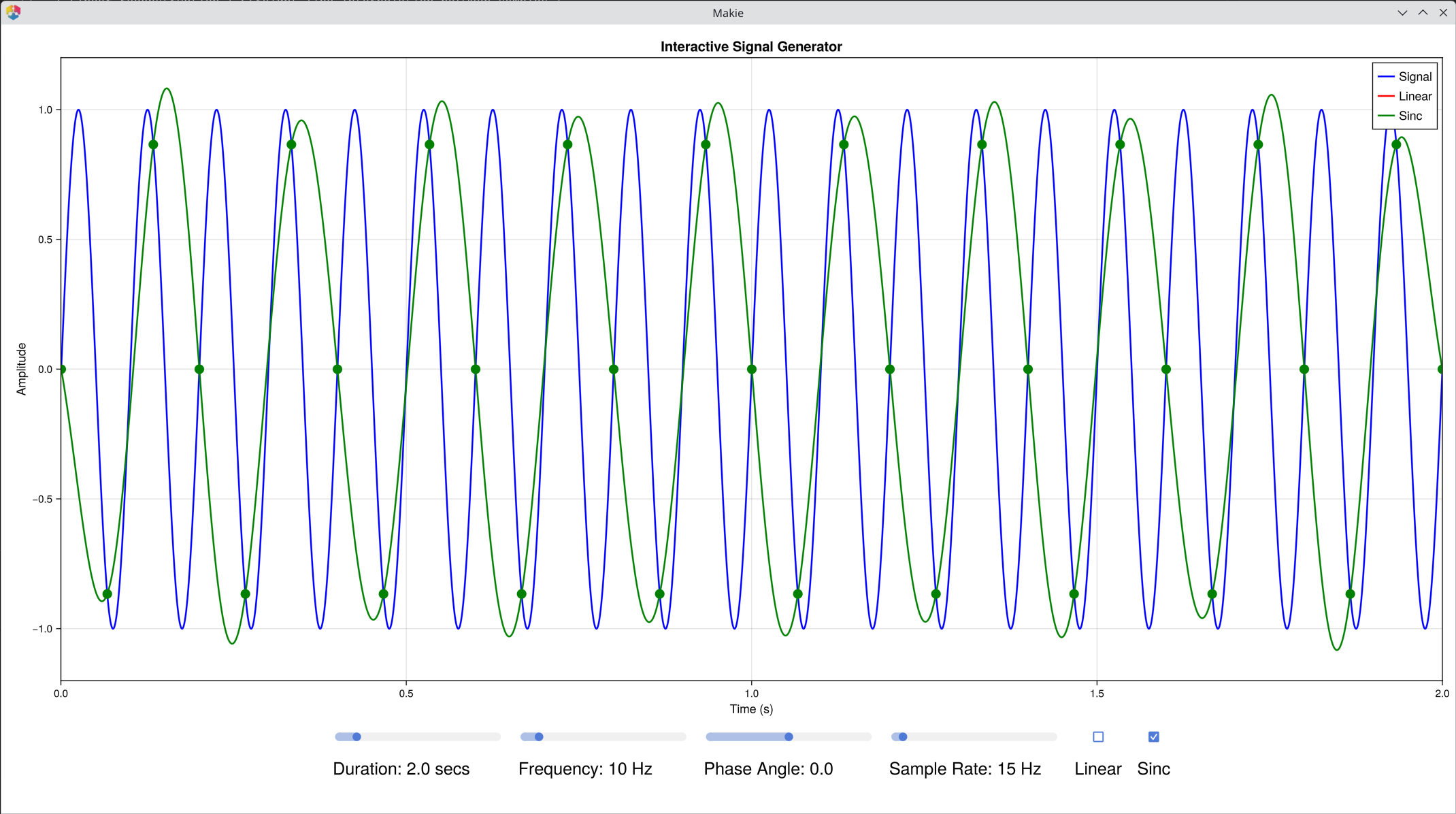
What it shows
| Feature | Description |
|---|---|
| Original signal | A "continuous" sine wave at the chosen frequency |
| Sampled points | The discrete samples taken at the chosen sampling rate |
| Linear reconstruction | Straight-line interpolation between samples |
| Sinc reconstruction | Whittaker–Shannon (ideal) interpolation |
Linear reconstruction connects adjacent samples with straight lines. It is simple but introduces distortion — particularly at low sampling rates relative to the signal frequency.
Sinc reconstruction uses the Whittaker–Shannon interpolation formula to reconstruct the signal exactly (within the Nyquist limit).
When the sampling rate falls below twice the signal frequency, the signal cannot be recovered: the sampled waveform appears at the wrong frequency — a phenomenon known as aliasing. Modern EEG systems typically sample at 256–2048 Hz, which is far above the Nyquist limit for brain signals of interest (usually < 100 Hz), ensuring faithful digitisation.
Things to Try
Start with a sampling rate well above Nyquist (e.g. 10× the signal frequency) and observe that both methods agree with the original signal.
Gradually reduce the sampling rate toward and then below the Nyquist limit (~2× the signal frequency) to show reconstruction breakdown and aliasing.
Enable both reconstructions simultaneously to highlight the superiority of sinc interpolation near the Nyquist limit.
Controls
| Control | Range | Description |
|---|---|---|
| Duration | 1–10 s | Length of the displayed signal |
| Signal Frequency | 1–100 Hz | Frequency of the underlying sine wave |
| Phase Angle | −π to π | Phase offset of the sine wave |
| Sampling Rate | 1–300 Hz | Number of samples per second |
| ☐ Linear | — | Toggle linear interpolation overlay |
| ☐ Sinc | — | Toggle sinc reconstruction overlay |
See Also
Luck, S. J. (2014). An Introduction to the Event-Related Potential Technique (2nd ed.). MIT Press. — Chapter 5 (Section: Amplifying, Filtering, and Digitizing the Signal, Figure 5.7)
Sinc Interpolation for Signal Reconstruction (Wolfram Demonstrations)
Signal Example — Composition — multi-signal composition and filtering
Signal Example — Dot Product — how the DFT detects frequencies
Signal Example — Spectrum — the full FFT power spectrum
Code
using EegFun
EegFun.signal_example_sampling()